
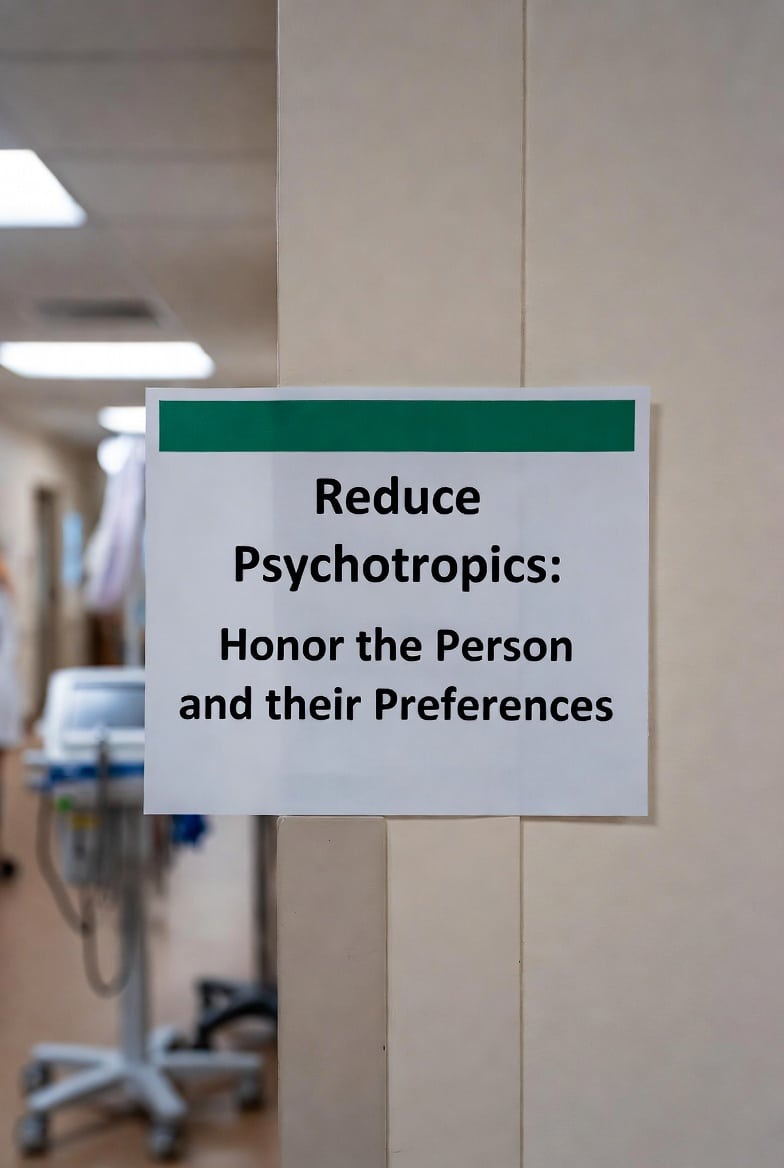
Even if you work in a setting not required to adhere to federal CMS regulations, consider them as standards of practice. Federal regulations are good. Besides, at this requirement, the following list are examples to use instead of psychotropic medications. As you read, please also consider if you were the person living where all these good examples were proactively discovered and provided for you.
CMS Tag F741 Non-pharmacological approaches.
Examples of individualized, non-pharmacological approaches to help meet behavioral health needs of all ages may include, but are not limited to:
- Ensuring adequate hydration and nutrition (e.g., enhancing taste and presentation of food, addressing food preferences to improve appetite and reduce the need for medications intended to stimulate appetite); exercise; and pain relief;
- Individualizing sleep and dining routines, as well as schedules to use the bathroom, to reduce the occurrence of incontinence, taking into consideration the potential need for increased dietary fiber to prevent or reduce constipation, and avoiding, where clinically inappropriate, the use of medications that may have significant adverse consequences (e.g., laxatives and stool softeners);
- Adjusting the environment to be more individually preferred and homelike (e.g., using soft lighting to avoid glare, providing areas that stimulate interest or allow safe, unobstructed walking, eliminating loud noises thereby reducing unnecessary auditory environment stimulation);
- Assigning staff to optimize familiarity and consistency with the resident and their needs (e.g., consistent caregiver assignment);
- Supporting the resident through meaningful activities that match his/her individual abilities (e.g., simplifying or segmenting tasks for a resident who has trouble following complex directions), interests, goals, and needs, based upon the comprehensive assessment, and that may be reminiscent of lifelong work or activity patterns (e.g., providing an early morning activity for a farmer used to waking up early);
- Assisting the resident outdoors in the sunshine and fresh air (e.g. in a nonsmoking area for a non-smoking resident);
- Providing access to pets or animals for the resident who enjoys pets (e.g. a cat for a resident who used to have a cat of their own);
- Assisting the resident to participate in activities that support their spiritual needs;
- Assisting with the opportunity for meditation and associated physical activity (e.g. chair yoga);
- Focusing the resident on activities that decrease stress and increase awareness of actual surroundings, such as familiar activities; offering verbal reassurance, especially in terms of keeping the resident safe; and acknowledging that the resident’s experience is real to her/him;
- Utilizing techniques such as music, art, electronics/computer technology systems, massage, essential oils, reminiscing;
My recommendation is to turn this list of examples from CMS Tag F741 into …
My Preferences List
- Food preferences:
- Individualized sleep:
- Individualized dining:
- Individualized use of bathroom:
- Individualized/preferred home environment: light, noise, belongings:
- Consistent/preferred care givers:
- Meaningful activities/engagement match interests/goals/needs:
- My preferences for outdoors, sunshine and fresh air:
- Pets/animals:
- Spiritual needs/meditation:
- Music:
- Art:
- Electronics/computer technology:
- Massage:
- Essential oils:
- Reminiscing/what to talk about from my life:
- De-stressors/F740 Understanding, preventing, relieving, and/or accommodating my distress or loss of abilities
In subsequent articles, we will take one good example at a time, flesh it out, enjoy thinking about it. As you do this the home where you work has the potential to become more compliant with this good requirement and, more importantly, well known for intentionally learning a person’s preferences and providing for them. Not knowing preferences leads to problems. Knowing and honoring preferences leads only to good things.

Carmen Bowman, MHS, Regulator turned Educator of Edu-Catering: Catering Education for Compliance and Changing Institutional Culture is an activities/engagement/community life, regulatory compliance and culture change consultant. She offers new or not-yet-qualified activity director consultation and personalized continuing education for professionals/teams/associations. At www.edu-catering.com join The Be Encouraged Blog, Become a Leader of Normal Life with the eResource GUARDIANS OF NORMAL LIFE: How Activity/ Recreation/ Engagement/Community Life Professionals can Save the World of LTC and share with your team the eBook Individualizing Medication Administration using Regulations. At the Edu-Catering YouTube channel, see the documentary that highlights changing institutional language Life Care Center of Casper Wyoming Culture Change Video 2023.
Leave a Reply